
Lane County City Directory Collections
The verified starting point for a Lane County city directory is a City of Eugene historic bibliography, not a claim that every edition is digitized or currently on a public shelf. That bibliography records a small but useful set of Eugene and Lane-area volumes. It establishes that the titles existed and were used in local historic work. It does not confirm the current holding location, a full run, a scanned page, or a reverse section for any given year. Those limits matter when a household cannot be found.
Begin with the title and year, then ask a local repository to confirm that a copy can be consulted. The sources below are a coverage map for the historic editions, not proof that a current reader can browse every volume remotely.
| Verified directory collection | Years cited | Evidence or repository route | Access status |
|---|---|---|---|
| Korstad's Eugene-Lane County Oregon Directory | 1934 | City of Eugene historic bibliography | Title verified; confirm present copy |
| Johnson's Eugene City Directory | 1936, 1938, 1940, 1942, 1949, 1953, 1955, 1958, 1960, 1962, 1964, 1965 | City of Eugene historic bibliography | Title and listed years verified |
| T. W. Salisbury's Eugene-Springfield-Cottage Grove & Lane County Directory | 1945 | City of Eugene historic bibliography | Confirm local availability before a visit |
| Eugene telephone directory | 1945/46 | City of Eugene historic bibliography | Historical citation, not a confirmed scan |
For an authoritative title list, consult the Eugene historic bibliography. It gives a narrower, more reliable foundation than filling missing years with assumptions.
Verified Lane County Historical Editions
These volumes are strongest as time-stamped observations. A listing can show how a publisher presented a person, address, occupation, or business connection for that edition. It does not by itself settle when someone moved, whether a residence was shared, or whether the entry was collected before publication. Compare an address across the nearest available editions, instead of treating a name that vanishes as a final answer.
Johnson's listed sequence has gaps, while the 1934 Korstad and 1945 Salisbury titles widen the view beyond Eugene proper. The regional wording in the Salisbury title is useful for a Lane County search, but it should not be read as a guarantee of equal coverage for every rural community. A telephone directory can supply another date layer, though it has its own listing and subscription limits.
Note: A missing name can reflect a gap in the cited editions, a listing choice, or a move, so confirm the physical volume before drawing a conclusion.
Lane County Historical Repository Checks
For a current shelf or scan confirmation, start with Eugene Public Library. Its downtown location is at 100 W. 10th Ave. in Eugene, and the city publishes current hours and locations separately. Ask staff for the exact directory title and year, local newspaper and genealogy references, or a referral to the holding institution. This is a practical counter route when a web search only reveals a bibliography.
University of Oregon Special Collections and University Archives is another primary-source route. Its Paulson Reading Room is in Knight Library, and researchers register and request material at least five business days in advance. SCUA's University of Oregon archive spans 1872 to the present and can offer publications, photographs, recordings, and institutional context. It should not be represented as a public student-residence directory.
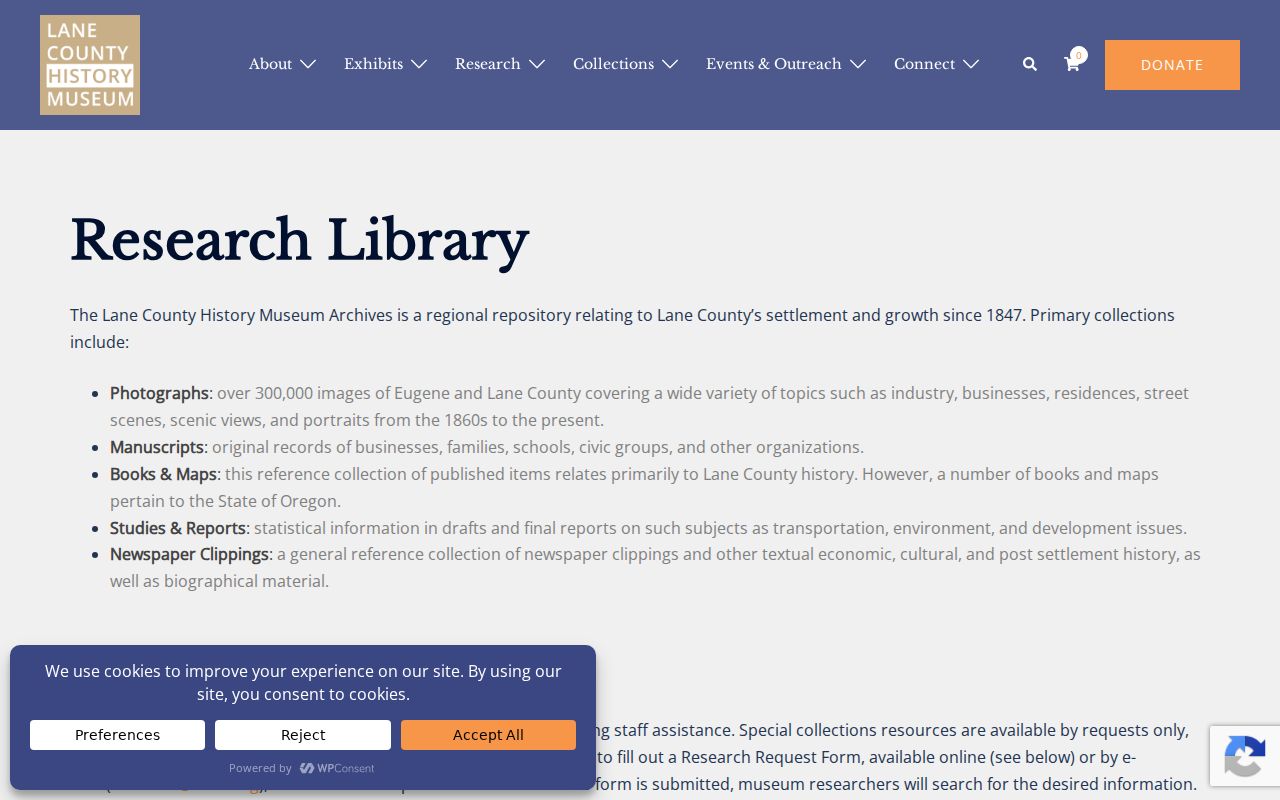
The Lane County History Museum research page shows the museum's archive and photograph-research route. It is a useful source contact for historical context after a directory address has been transcribed.
The Lane County History Museum research page is shown below as the local archive-contact route.
Reading a Lane County City Directory Entry
No scanned Eugene directory page was verified in the research, so the exact column labels and abbreviations for a local edition should not be invented. When an authentic volume is open, record only what appears on that page and photograph or copy the publisher's key. The following inventory is a checklist of categories to inspect, not a claim that every Lane County city directory used each field or abbreviation.
| Name | Transcribe surname, given name, initials, and spelling exactly as printed. |
|---|---|
| Family notation | Inspect for a spouse reference, widow notation, or other relationship wording only if the page shows it. |
| Work information | Record an occupation, employer, or business address only when included in that edition. |
| Address | Separate a home address from a business address and preserve the printed street form. |
| Status marks | Check the publisher's own key before interpreting an owner, renter, or other mark. |
- Criss-cross directory
- An address-ordered companion volume, if a repository confirms one exists, used to find the directory-listed name at a given address.
- Householder index
- An index arranged around household or address information; its scope varies by publisher and must be checked in the volume.
- Abbreviation key
- The publisher's explanation of printed shorthand. Copy it from the same edition rather than importing a key from another city.
A city directory entry is a historical lead. It can point toward an address, event, or record set, but it does not establish present residence or identify everyone in a household.
Lane County Historical Context at LCHM
The Lane County History Museum's digital collection adds visual and manuscript context to a historical listing. The museum reports a searchable manuscript index, more than 40,000 digitized images, and the Don Hunter collection, estimated at 172,000 slides documenting Lane history from 1938 through 2002. Streetscapes and catalog leads may help date a business sign, block, or neighborhood change. They are corroborative evidence, not proof that a named person lived at a property.
The museum's permanent exhibits also identify the preserved 1853 Lane County Clerk's Building. That local records history is a useful reminder that directory work often reaches back through separate repositories rather than a single database.
Eugene Public Library's magazines and newspapers resource is shown below as another local-history referral point.

Historic Indexes Beside Lane County City Directories
Several Lane and Oregon archival runs can steady a city directory trail. The Oregon Archives guide identifies Lane death notices from 1864 to 1902, a divorce index from 1855 to 1900, a marriage index from 1853 to 1950, and marriage records from 1852 to 1891. The Lane Deeds & Records Research Library holds local birth and death abstracts for 1882 to 1915. These are historical leads and do not override restricted modern vital-record rules.
The Oregon Archives vital-record guide asks researchers to provide a name, event date, city, and county for a research or copy request. The State Archives also holds territorial assessment rolls for 1854 and 1857 to 1859, along with early probate material. For family history, a dated directory listing can therefore be tested against a more independent record rather than repeated across secondary sources.
Note: A historic index is not the same thing as a certified record, and access depends on the record type, date, and the custodian's rules.
Trace Lane County City Directory Households
Trace one household in a slow sequence. Start with a fully cited directory entry. Next, seek the same spelling and address in the next verified edition, noting changes without guessing at their cause. If a repository confirms a criss-cross or reverse section, compare the address there. Then pair the year with the nearest released federal census, a tax or deed record, and a dated newspaper item. The latest released federal population census is 1950, so it is an interval check, not an annual directory substitute.
- Write down the exact directory title, year, page, printed name, and every address type shown.
- Check another verified edition for a move, spelling variant, occupation change, or a different address.
- Ask the repository whether an address-ordered companion exists before assuming a criss-cross section is available.
- Compare the directory year with the nearest released census and with a deed or tax record tied to the same place.
- Use a newspaper notice or archival vital index as a lead, then preserve the source and date for each comparison.
A name may disappear because of a move, death, an unlisted household, publication timing, or an incomplete surviving run. Treat each possibility as a question for another source. When a historical address becomes a modern parcel question, the Lane County street directory has the current address-keyed record route.
Lane County City Directory Streets in Context
Address comparison needs a land-history check in older Eugene records. The city's historic residential guidance describes the 1851 first town plat and later subdivision of large donation-land claims. Rail connections changed local building patterns in the 1880s, and the 1909 to 1912 boom created 50 additions and subdivisions, including bungalow tracts in Fairmount, West University, Whiteaker, Westside, and Jefferson. A printed street address may therefore need a plat or legal-description check before it is carried across eras.
Lane County's Surveyor collection has road maps, road-naming files, subdivision documents, and other records from about 1851 forward. Its historical Alpha Road Index points to viewers' reports, ordinances, plats, and field notes from about 1854 through 1980. No blanket Lane or Eugene renumbering year was verified, so a claimed old-to-new address match needs record support rather than a general rule.
| 1851 | Eugene's first town plat provides an early land framework. |
|---|---|
| 1880s | Rail connections changed building and material patterns described in the historic guidance. |
| 1909-1912 | Fifty additions and subdivisions accompanied a local building boom. |
| 1854-1980 | The Alpha Road Index points to road-name, plat, ordinance, and field-note records. |
Note: Preserve the historic street wording first, then use plats, road records, and legal descriptions to test a modern address match.